Identification media, locking devices and the locking plan - AXM Classic
Using identification media
The collective term identification medium refers to all components with which a person can identify themselves on a locking device. This primarily includes:
- Transponder
- Cards (smart card)
- Tags (smart tag)
- PIN code keypad
|
|
|
|




Identification media can communicate using the following technologies:
- Active technology (25 kHz)
- Passive technology (RFID, 13.56 MHz)
- Bluetooth Low Energy (BLE, 2.4 GHz)
- Active identification media (= transponders, PIN code keypad 3068) have a battery and can start communicating with a locking device themselves (actively).
- Passive identification media (= cards, tags) do not have a battery and must be powered by the locking device via an induction field. Only then can you communicate with the locking device.
- Identification media with BLE (= PIN code keypad AX and AX2Go) have a battery like active identification media, but communicate with the locking device via BLE.
Each technology offers advantages, depending on its specific use.
Your cards and transponders have two numbers that are important:
- Serial number (permanently stored in the identification medium and imported during synchronisation)
- TID (flexibly assigned by AXM Classic and written on the identification medium during synchronisation)
The serial number is a unique number for each identification medium while the TID is only unique in your locking system.
The database establishes a link between the imported serial number and the TID (transponder ID) during synchronisation. This means that AXM Classic knows which serial number and which TID belong together.
However, this link is confined to AXM Classic and is not written onto identification media or locking devices. A locking device uses the TID (and not the serial number) to check whether an identification medium is authorised or not.
Passive identification media have physical limitations when put to use (see Cards and locking device IDs).
About locking devices
The collective term “locking devices” refers to all components which are “activated” with an identification medium. Locking devices are usually installed in or on a door (except SmartRelay). Locking devices primarily include:
- Locking cylinders
- SmartHandles
- SmartRelays
- SmartLocker
|
|
|
|




Locking devices can also communicate with identification media using different technologies:
- Active
- Passive
- BLE
It is important that the technologies used match. A passive locking device can normally only be opened with a passive identification medium, but not an active one.
Like an identification medium, each locking device has two important numbers:
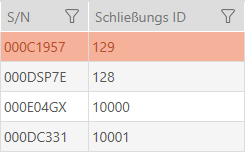
- Serial number (permanently stored in the locking device; imported during synchronisation)
- Lock ID (LID for short; flexibly assigned by AXM Classic and written onto the locking device during synchronisation)
The database establishes a link between the imported serial number and the LID in the database during synchronisation. This means that AXM Classic knows which serial number and which LID belong together. However, this link is confined to AXM Classic and is not written onto identification media or locking devices. A locking device uses the TID (and not the serial number) to check whether an identification medium is authorised or not.
Normally, you don't need to concern yourself with the TID and LID as your AXM Classic does everything in the background.
About the locking plan
Put very simply, the matrix is mapped and saved to the locking plan. Among other things, it contains the authorisations. Thanks to the locking plan, locking devices and identification media know who is authorised to use either.