Creating transponders and cards - AXM Plus
NOTE

Activating cards or transponders for a locking system
The only credential types available are those that have been activated in your locking system.
- If necessary, activate cards or transponders in the locking system properties (see Enable cards or transponders).
In the interests of best practice (see Best practice: setting up the locking system), SimonsVoss recommends that you configure access levels, person groups and schedules/time groups:
- Access levels (see Access levels for background information )
- Creating a person group (see Person groups for background information )
- Creating a schedule or Create time group (see Time groups and schedules for background information )
- Click on the
 button.
 - The window for creating an identification medium will open.
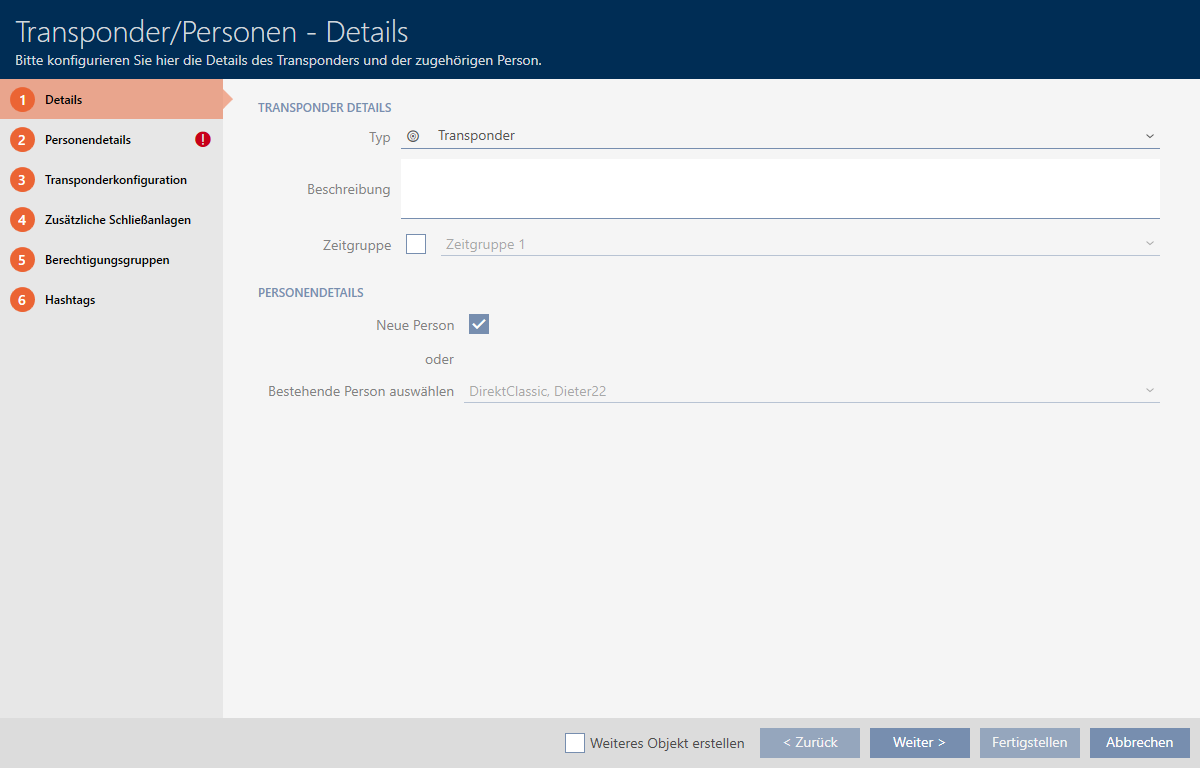
- Select the identification medium you wish to create from the drop-down menu.
- Enter a description if required.
- If the identification medium is to feature time-controlled authorisations: select the
 Time group checkbox.
 - Select the time group from the drop-down list (e.g. ).
- Activate the New person check box.
- AXM Plus will automatically create a new person for the new identification medium. Deactivate this check box to select an existing person (e.g. for a second identification medium or a replacement identification medium).
- The tab is shown.
- Click on the tab.
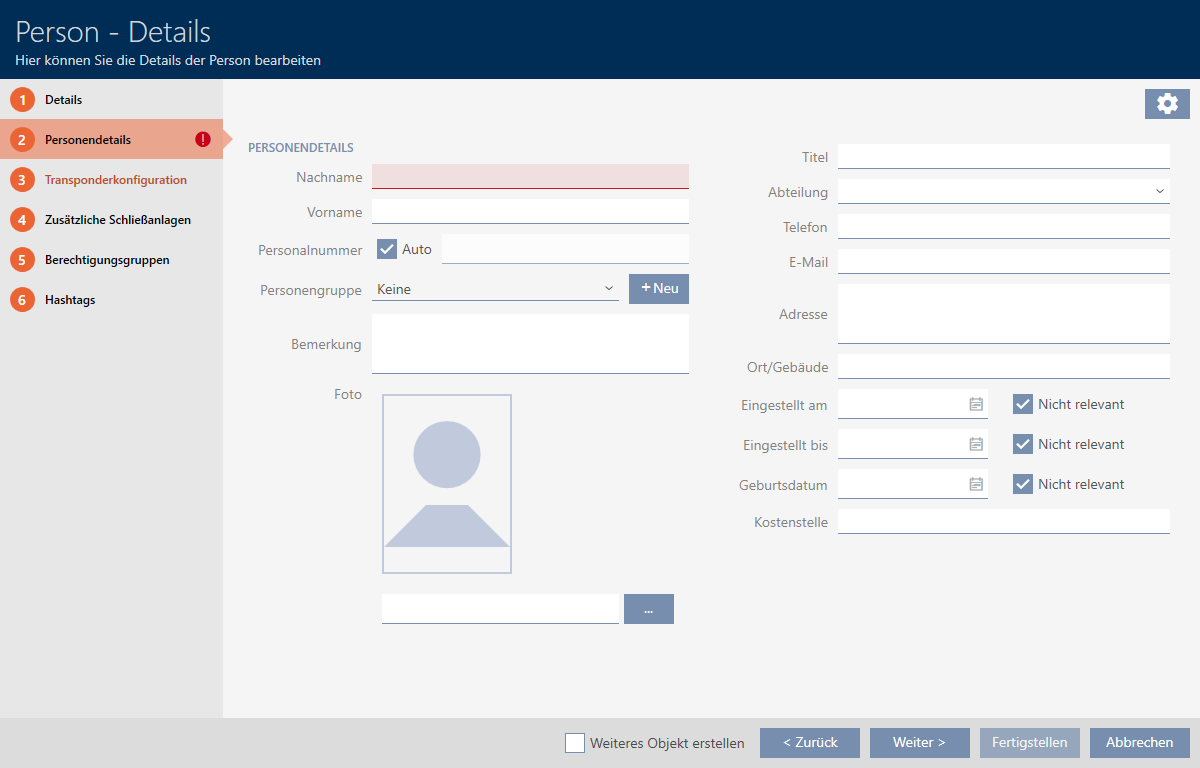
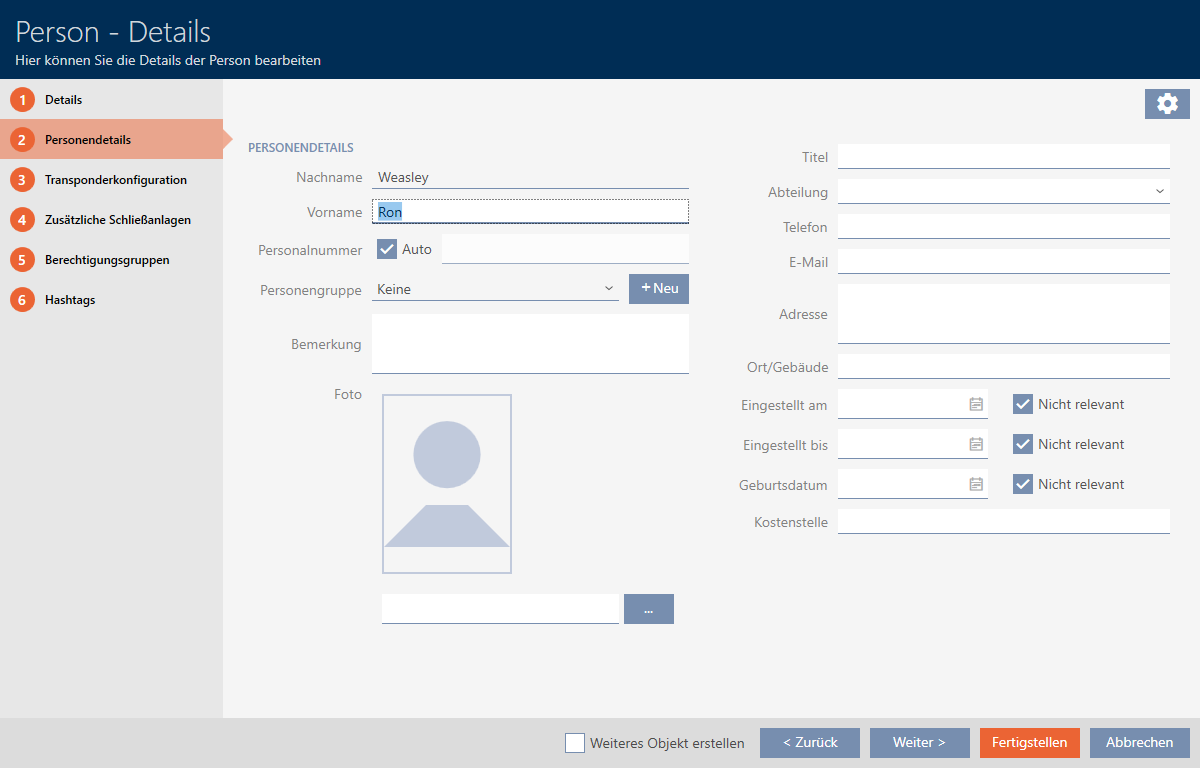
- Enter the surname and first name of the person who will receive the identification medium in the and fields.
- The surname and first name will be displayed in the matrix at a later point in time.
- The personnel number is generated automatically.
NOTE
Personnel number formula or manual entry
The AXM Plus generates personnel numbers based on the following formula: PN-1, PN-2, PN-X. The abbreviation PN can be changed if required (see Changing automatic numbering).
Alternatively, you can enter personnel numbers manually:
- Activate the
 Auto check box.
 - The field is activated.
- Enter the personnel number in the field.
- Activate the
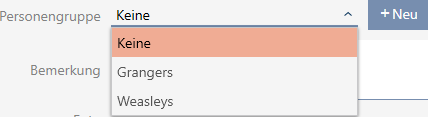
- If you wish to assign this person to a person group: Select the person group to which this person belongs from the drop-down menu.
- Give further details about the person if required.
- You can then simply select the information you enter in the field from a list for other persons.
- If you want to edit the , or fields: Deactivate the relevant Not relevant check box.
- Use the button to switch to the next tab or complete the entries with the button.
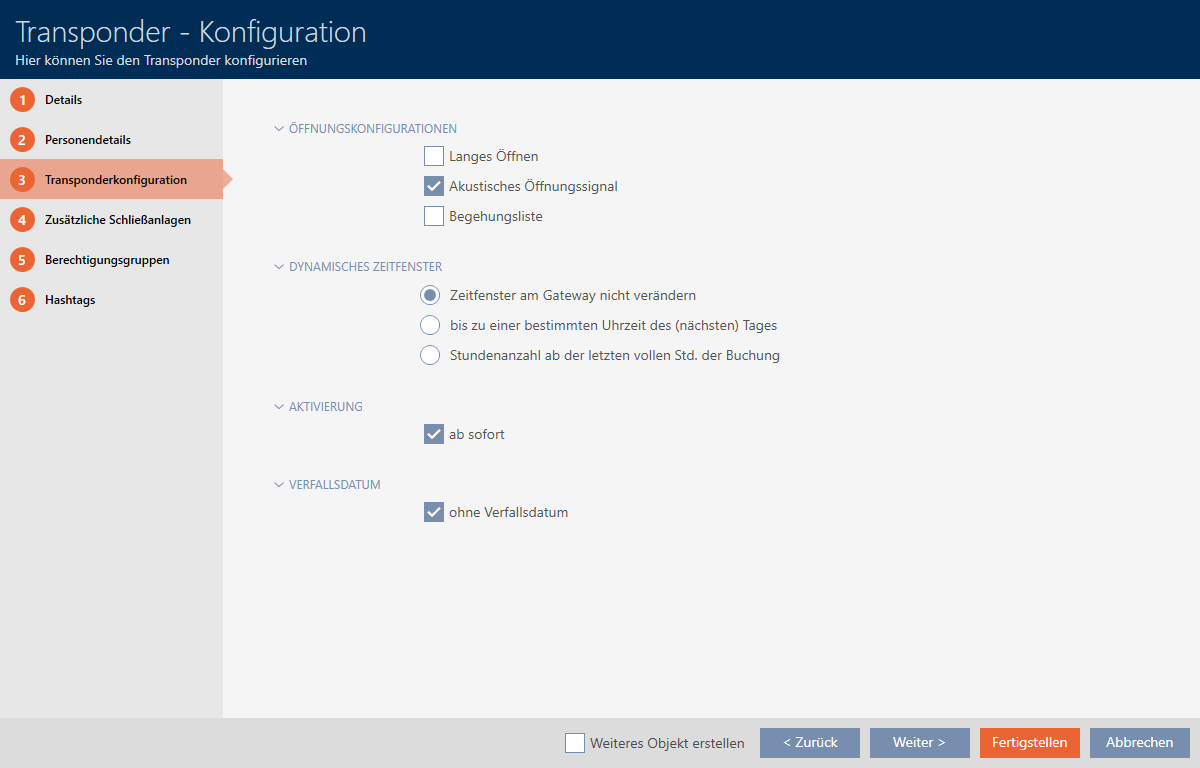
- If locking devices need to open twice as long for this identification medium (doubling to max. 25 s): select the Long opening checkbox.
- If you don't wish locking devices for this identification medium to beep: disable the No acoustic opening signal checkbox.
- If you need to save the locking devices on which the identification medium was used on the identification medium: select the Personal audit trail checkbox.
- Select one of the three options in the area (see Time budget (AX2Go and virtual network)):
 Do not change time window on the gateway option: Does not use time budgets.until a particular time of (next) day option: Authorisations for this identification medium expire at a specific time and can only be renewed at the gateway.Number of hours from the last full hour of the booking option: Authorisations for this identification medium expire after the specified number of hours, but can be extended or renewed at any time at the gateway.
 NOTE
Gateway to renew time budgets
If you select the
Number of hours from the last full hour of the booking or until a particular time of (next) day option, your users will need a gateway to reload their time budgets.- If you do not want the transponder to be usable immediately: disable the from now checkbox. Then enter an activation date.
- If the transponder is only to be used for a limited period of time, disable the without expiry date checkbox. Then enter an expiry date.
- Use the button to switch to the next tab or complete the entries with the button.
- If you wish to use the identification medium in other locking systems in this project: Use the button to add further locking systems (see Use identification media in multiple locking systems).
NOTE
Limitations for Transponder - Additional locking systems
Depending on the type of identification medium, different volumes of memory space are available for additional locking devices (e.g.: G2 transponders can store four G2 locking systems). The locking system also needs to support the identification medium (e.g.: transponders cannot be used in card-only locking systems).
- Make sure that there is sufficient memory space on your identification medium.
- Make sure that the required locking system supports your identification medium. Upgrade the locking system if necessary (see Enable cards or transponders).
- Ensure that the locking system memory spaces do not overlap in the case of cards.
- Use the button to switch to the next tab or complete the entries with the button.
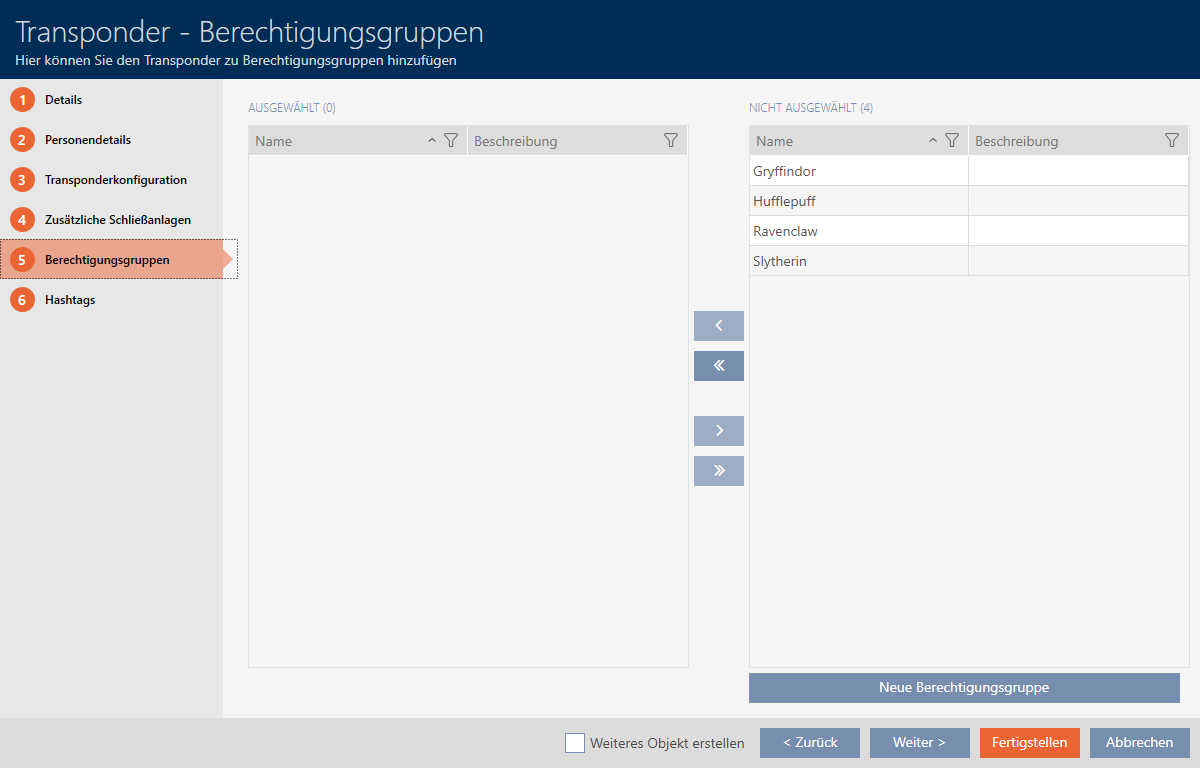
- Use
 to sort/filter the displayed entries if required (see Sorting and filtering).
 - Select the required access levels in the right column (Ctrl+click for single groups or Shift+click for multiple groups).
- Use
 to move the selected access levels only or
  to move all displayed access levels.
 - The identification medium is assigned to the highlighted access levels.
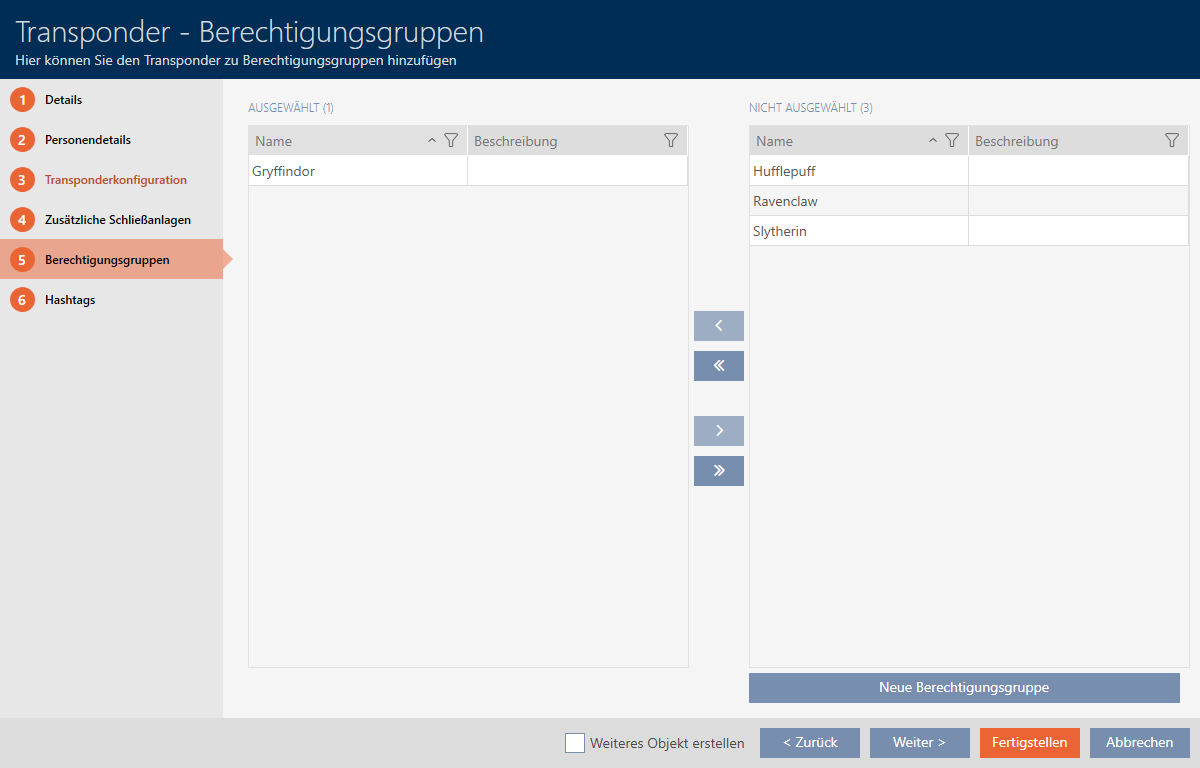
NOTE
Double-clicking as an alternative to arrow keys
Double-clicking an entry in the list will also move this entry to the other column.
- Use the button to switch to the next tab or complete the entries with the button.
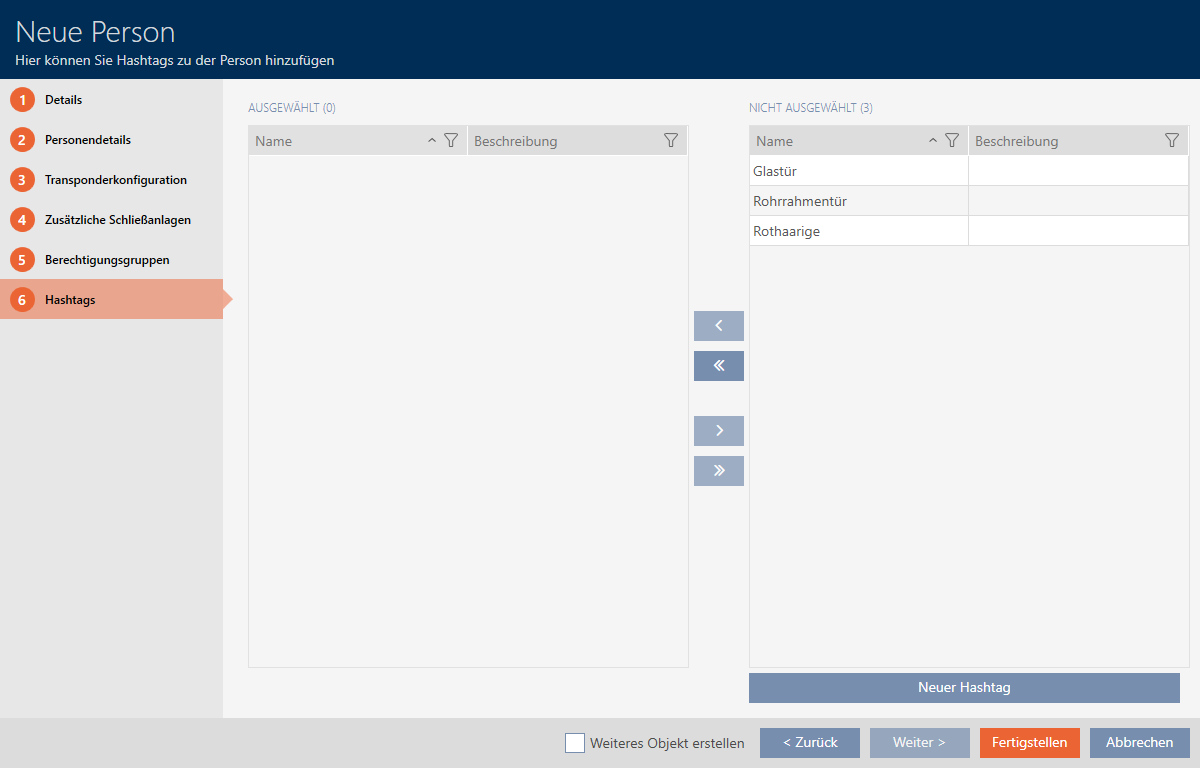
- Use to sort/filter the displayed entries if required (see Sorting and filtering).
- Select the required hashtags in the right column (Ctrl+click for single hashtags or Shift+click for multiple hashtags).
- Use to move only the selected hashtags or to move all hashtags.
NOTE
Double-clicking as an alternative to arrow keys
Double-clicking an entry in the list will also move this entry to the other column.
- The highlighted hashtags in the left-hand column are used for this identification medium.
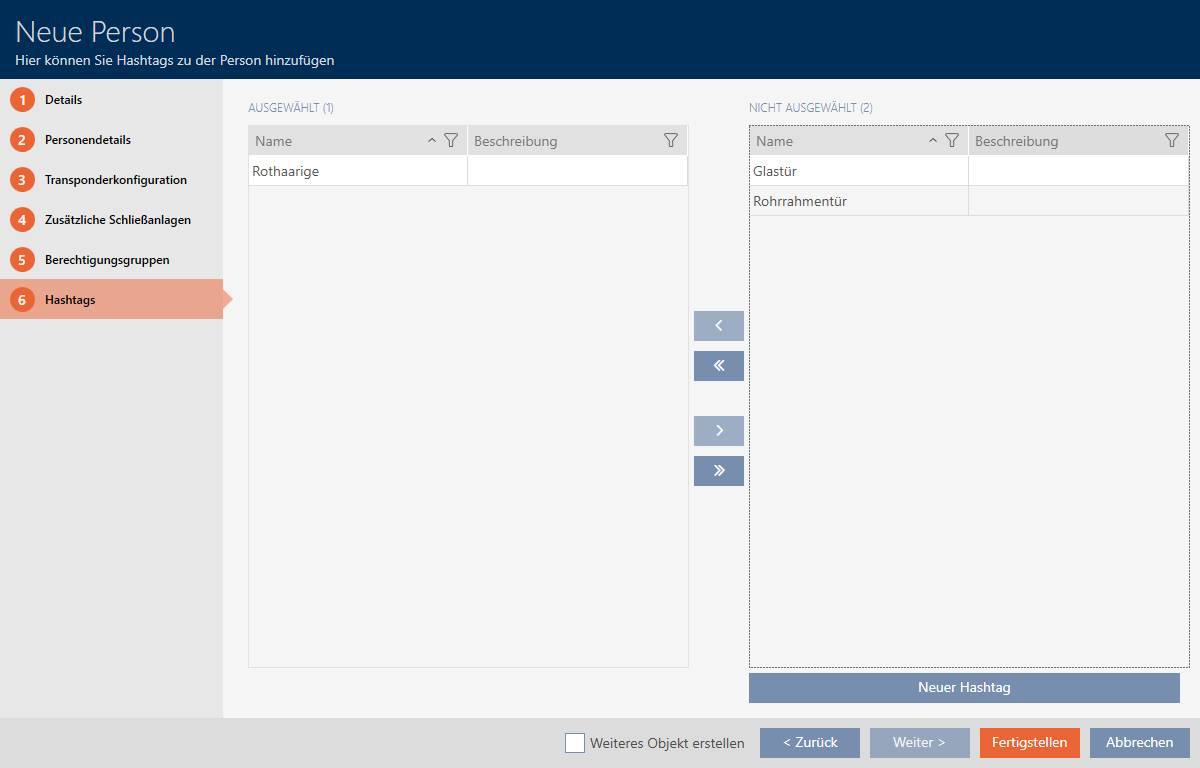
- Select the Create additional objects checkbox to leave the window with the same settings open for the next identification medium to be created.
- Click on the button to create the identification medium.
- The window for creating a new identification medium closes.
- Newly created identification medium is listed or displayed in the matrix.
Also see
- Identification media, locking devices and the locking plan
- Access levels
- Best practice: setting up the locking system
- Access levels
- Creating a schedule
- Create time group
- Changing automatic numbering
- Sorting and filtering
- Time groups and schedules
- Use identification media in multiple locking systems
- Enable cards or transponders