Snap-in - SmartHandle 3062
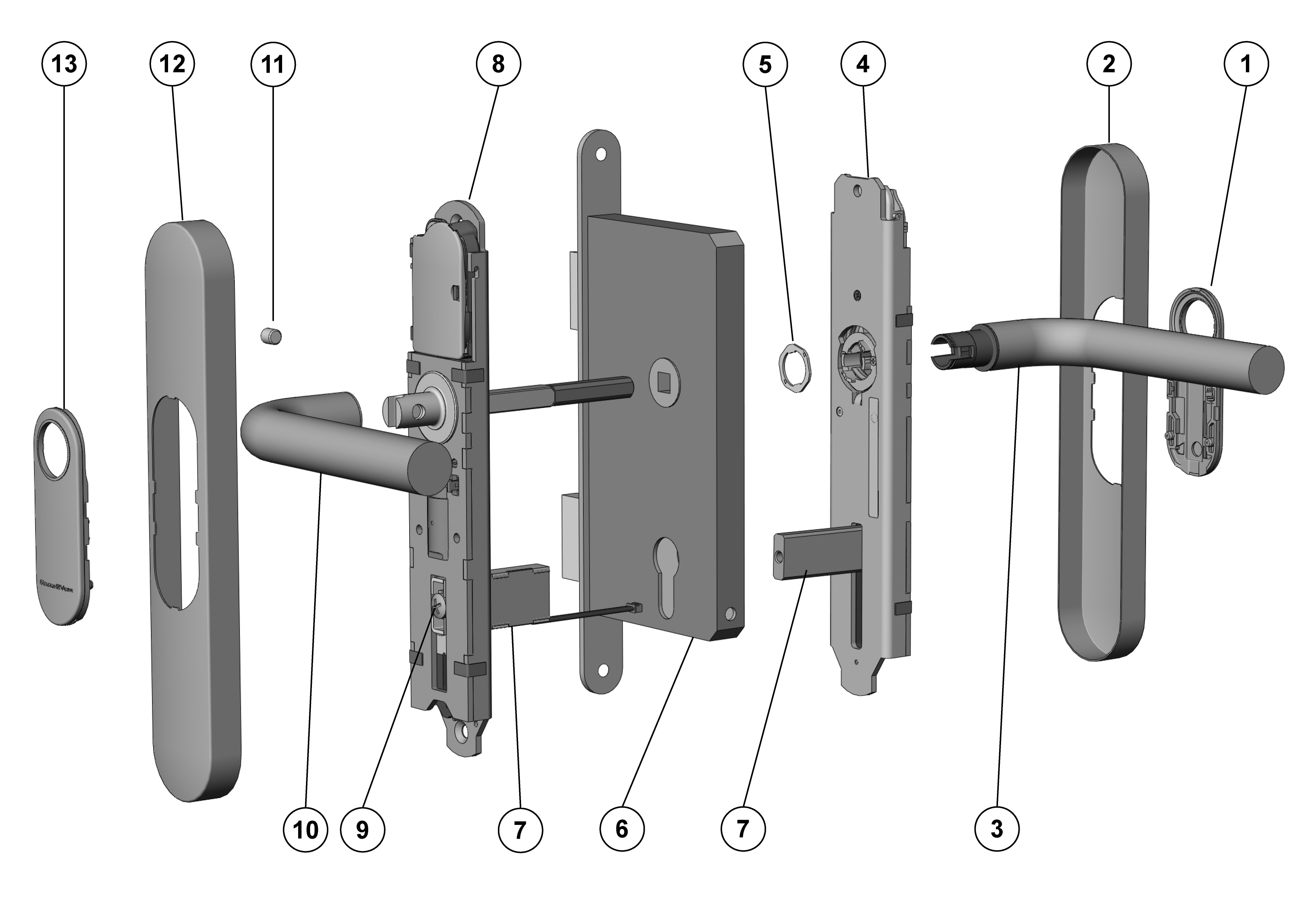
Key:
- Inlay
- Inlay
- Outside handle
- Outer fitting
- handle fastener piece
- Door lock (not included in the scope of supply)
- Snap-in mechanism
- Inside fitting
- Screw
- Inside handle
- Inside hexagon screw
- Inlay
- Inlay
Installation:
- Optional: handles, escutcheons, fittings and other door furniture fitted to the door are to be removed.
- Optional: Fasten mortise lock into the door
- SmartHandle is partly assembled when delivered; see Disassembly.
- The inlay cannot be fitted on some handles, such as offset handles, when they are already installed. Push the inlay onto the outer handle with the logo facing outwards in such cases. You can do this with most handles.
- Push inlay (1) onto the outer handle (3). Depending on the handle model, it may not be possible to fit it once the handle is installed.
- Insert outer handle (3) horizontally into the outer fitting (4), placing it in the direction that you require, depending on whether it is a DIN left-hand or right-hand door.
- Place handle fastener piece (5) into position (see Diagrams 2 and 3).
- Hold the outside handle (3) and use the spanner to rotate the fastener piece (5) about 75° to the right until it fits into position (Diagrams 4 and 5). If you do not fit it correctly, the handle may come loose again.
- Optional: In a lock with an 8.5 mm or 10 mm spindle, push the corresponding sleeve (8 mm --> 8.5 mm [not included in the supply package] or 8 mm --> 10 mm) through the retainer opening in the mortise lock from the inside.
- Push the 3-pole inside fitting cable into the snap-in mechanism (7). This protects it from external impact during installation (Diagram 6).
- The inside fitting (8) is mounted onto the inner surface of the door. The inside fitting (8) is fastened to the door by sliding the spindle through the retainer slot and the snap-in mechanism through the mortise lock (6) cylinder opening at the same time.
- Push the inside fitting (8) until it is flush with the door.
- Remove the cables from the snap-in mechanism (7), so that they hang freely out of the door and are not damaged (Diagram 7).
- The outer fitting (4) is mounted from the outer side of the door. Push the spindle slot in the outer fitting (4) onto the spindle while pushing the snap-in mechanism (7) on the outer fitting (4) into the snap-in (7) on the inside fitting (8).
- Push on outer fitting (4) until it is about 1 cm from the door.
- Push the inside fitting 3-pole cable through the elongated hole in the outer fitting. Do not pull on the cable while doing so (Diagram 8).
- Connect the 3-pole cable from the inside fitting to the 3-pole cable from the outer fitting. This cable can only be inserted in one direction. Do not pull on the cables while doing so; just carefully secure the plug-in connection into position.
- Optional: Connect the 2-pole cable from the LockNode to the 2-pole cable from the inside fitting.
- The 2-pole cable from the outer fitting can hang freely, but must not get caught when the outer cover (1) is fitted. Do not pull on the cable.
- Press outer and inside fittings together, so that they are both flush against the door.
- Push mounting screw (9) through the snap-in mechanism (7) from the inner side of the door and tighten by hand, using about 5-7 Nm.
- Check that the outer handle (3) can turn easily; if it does not, there may be a problem with the lock or the handle may have been fitted incorrectly. In case of doubt, disassemble components and start again from Step 7. Depending on the handle model, it may not be possible to fit it once the handle is installed.
- Push inside handle (10) onto the inner fitting (8) fastening flange until it will go no further.
- Tighten the hexagon screw (11) on the inside handle (10) by hand, so that it is flush with the handle.
- Push the cover (12) over the inside handle (10).
- Carefully push the inlay (13) through the opening in the inside cover (12).
- Push the cover (12) onto the inside fitting (8), so that it is flush with the door. The cover is not symmetrical; look carefully at the marking to ensure correct positioning (Diagram 10).
- Click the inlay (13) carefully into the cover (12).
- Push the cover (1) over the outside handle (3).
- Carefully push the inlay (1) through the opening in the outside cover (2).
- Push the cover (2) onto the outer fitting (4), so that it is flush with the door. The cover is not symmetrical; look carefully at the marking to ensure correct positioning (Diagram 10).
- Push the inlay (1) over the handle (3) and click it into place in the cover.